
Power plants were initially built by Hollanders to support sugar mill plants and tea factories to keep running in the last of the 19th century. However, not until October 27 1945, those powerhouses were handed over to Soekarno which then the company was renamed to Jawatan Listrik and Gas. This is the forerunner of PT PLN today and the date was then established to be the National Electricity Day.
After 78 years of the first establishment, nowadays electricity does not solely support factories but also becomes the lifeblood of almost all activities in the nation. It supplies power to houses, hospitals, schools, and many public and private places in Indonesia. Thanks to the effort made by the government and the company itself, Indonesia is now 99.63% powered by electricity.
But, how about the remaining 0.37%? Why until the commemoration of 78th national electricity day, electricity is still exclusive to some Indonesians living faraway from capital cities and main islands? What is the possible best solution to equitably share this privilege to the rest of Indonesian whilst ensuring its future sustainability?
Indonesia’s Power Distribution: Accessibility and Reliability
The need for equally distributed and reliable electricity is critical. However, Indonesia is still experiencing some challenges. Frequent power outages and lack of electricity access in some parts of Indonesia are a serious problem that must be addressed.
In terms of reliability, data from the World Bank reveals that amongst ASEAN countries, Indonesia’s power stability is still the least developed compared to Vietnam, Malaysia, Thailand and Singapore. Precisely, the 2020 System Average Interruption Duration Index (SAIDI) from the four countries were 2.07, 0.48, 0.38 and 0.06 hours of experienced power outages per customer per year respectively, while SAIDI of Indonesia is 2.82 hours per customer per year. Furthermore, following the figure below, after three years away from 2020, only five regional holding units (UIW) are successful to attain relatively low power outages of less than the national SAIDI level in 2020, with Jakarta being the least impacted by the power outages of only 0.6 hours per customer per year.
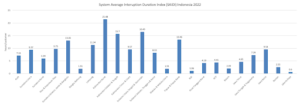
Meanwhile, in terms of electricity access, it is recorded that last year, of about 4,700 villages in the outermost, frontier, underdeveloped regions (3T) hardly had access to electricity. On the provincial level, several UIWs have an electricity ratio of less than 90%. These are, Papua mountain range (12.09%), Central Papua (47.36%), East Nusa Tenggara (69.06%), South Papua (73.54%), North Maluku (87.42%), Southwest Papua (87.67%), West Papua (88.35%), Papua (89.22%), Yogyakarta (89.33%), and West Sulawesi (89.48%). Consequently, the majority of these regions experience a slower economic growth than other regions, hence slowing down the regional development and risking the well-being of its residents.
To overcome these problems, comprehensive understanding of the root cause is beyond required. Firstly, power outages can be stemmed from the disruptions in the transmission/distribution system, and limited energy supply. Meanwhile, lack of electricity access in the 3T region is usually linked with its remote location, increasing technical difficulties when connecting to the existing grid and uproaring the installation cost.
Providing Power with Sustainability in Mind
Currently, electricity consumption in the country reaches 273 TWh, with more than 60% of this demand is supplied from coal, ±23% from oil and natural gas, and less than 17% is supplied from hydropower, geothermal, and bioenergy. Consequently, power generation becomes the most dominant sector that contributes to the national greenhouse gasses emission. Cited from the Climate Transparency report, the share of emission from the power sector constitutes 65% from the national inventory in 2019. Moreover, with electricity demand projected to grow due to increased electrification from transport and industrial sectors, it can be expected that future GHG emission will grow extensively in 2060, if no interventions are made.
With threats from climate change becoming evidently clearer day by day, the need to balance between investing more in electricity infrastructure and the necessity to free Indonesia’s electricity mix from unsustainable energy sources is a must.
Cooperation between the government, private sector, and society is needed to achieve the goals of reliability, sustainability, and emission reduction. Concrete steps, such as investment in electricity infrastructure, increased use of renewable energy, and increased use of energy-efficient appliances, are steps that must be taken. This will provide long-term benefits for future generations and ensure that Indonesia’s electricity remains the backbone of the country’s progress, not the other way around.
